Repair #1 was changing the transmission fluid and seeing if we could get the code read. The fluid was burnt, brown and stinky, not red like it was supposed to be. We got the fluid changed for $20. I would do it myself normally but it requires removing the whole transmission pan and disposing the old fluid. I didn’t want to have to figure out how and where to get rid of the old fluid, plus I usually get covered with the stuff and I didn’t want to do that either. For $20, it was a no-brainer. The new fluid cost $50 and was a pain to find. The guy changing the fluid for me has his friends drive me around to six different “lubricantes” stores looking for Ford tranny fluid, a rarity in Peru. After an hour and the second visit to one store, we found two gallons. I made the guys who drove me around take $4 for the effort. They didn’t want it until I suggested they buy themselves some beer. The scanner the mechanic had didn’t fit our old Ford computer plug, so no reading. The code light began flashing again on my way from the repair shop to our camping spot (a gas station, of course). Frustrating.
Repair #2 was installing new front brake pads. I had already put new pads on once in Ecuador. We had come down a massive 6,000 foot mountain decent (one of at least a dozen so far) and the pads were smoking and making the “change me now!” sound. We stopped at a gas station on the highway and Ryan and I took a taxi into the town another 1,000 feet down the hill. The driver drove us to a part store and by some miracle, there were Ford F-250/350 pads there for $20. I couldn’t believe it! Anyway, $20 pads wear out pretty fast in the Andes and it was time for a change in Abancay, especially with a new venture into and up and down the Andes ahead. In Ecuador there were lots of Ford trucks and cars, but Peru was different. I wouldn’t see a Ford for days, and when I did it was at least 40 years old. There were no pads in Abancay. In South America, that doesn’t matter. Why? Because you just go to the brake specialist who grinds off what ‘s left of your pad off the shoe (think asbestos, shirt over mouth in front of bench grinder job), puts on some nasty smelling glue, and cuts new pads to custom fit your shoe. Not only that, but Abancay, being at 8,500 feet on the way to Cusco, meant these guys knew brakes. At least 60% of the streets in this town were at least 20% grade, with several being well beyond 30%. San Francisco has NOTHING on this place. Now I have the best looking metallic pads I’ve ever seen on the van, at a cost of $28.
Repair #3 We have been having problems with the van starting and I couldn’t figure out why. Starting the van had devolved into getting out the generator, hooking up the battery charger and making several attempts to get her going every day. I was getting pretty frustrated. I had the starting system checked in Denver (a long time ago) and it was determined we needed a new alternator, which we got, but everything else checked out. The current theory was we needed new battery cables, or possibly new batteries (we take two). I yanked the 3 cables in question (one got replacedearlier, in Texas, I think) and went off to find new ones. I ended up with three guys back at the van who, after a few minutes, I learned didn’t understand my problem, even though “necesarios nuevos cables” was pretty straightforward, I thought. I’m pretty sure they were just trying to get some money out of me, so I sent them away. When I disconnected the one battery cable from the starter solenoid, I found that the generator/charger method of starting the car had taken its toll on the connection. The plastic cap on the solenoid where the cable connects had cracked due to too many starting attempts (I know, I know) and the bolt came right out of the unit. At this point, Repair #3 evolved into something else. Across the street from our gas station was a metal worker who we’ll discuss more in Repair #5. I asked him if he could recommend a good auto electronic repair person in Abancay. Yes, he said, see that aluminum door right up the street? He is there. I would have never known as there was no indication that any sort of shop was there at all. Just a lovely house where he had his shop and worked out of. I brought him the starter and the battery cables and found out my cables were just fine. Thus endth Repair #3. The starter, however, led to Repair #4.
Repair #4 So now the starter (actually the solenoid) was missing the threaded part to bolt the cable from the batteries on to it. I pretty much figured we would be stuck in Abancay for another week while a starter came in from I don’t know where. I took the thing to the aforementioned mechanic up the street and showed him the problem. It turns out this guy had been an automotive electrical mechanic for over 40 years and had saved EVERY spare piece to ever come off anything he worked on. He took the solenoid apart, which involved melting solder and such, and found in his box of like 200 plastic solenoid caps the ONE (and only) to fit my solenoid. Unbelievable! He bench tested the starter, which worked fine, and the solenoid, again fine, and put them back together. There was a problem. There was no electrical contact in the solenoid to fire the starter. He decided this was because the solenoid housing, a metal tube about 2 inches around and 4 inches long, was too long for the contact to be made with the new cap. He sent me back down the street to the metal worker we’ll talk about shortly to cut off a quarter inch from the tube. Two dollars to the metal worker and 30 minutes later, I was back. Everything got put together and checked out great! Back in action. Total cost to the electrical mechanic: $27.50
Repair #5 This isn’t actually a repair, yet. After the starter was reinstalled, it had a new problem where it would turn on and try to start the car even when the key was off and not even in the ignition! Hmmmmm. After all the other stuff that I had been dealing with up to this point, I was starting to lose it. I’m sure the family would attest to that. Michelle, ace researcher of the world, got on the internet and in a few quick minutes found some Q/A session where a guy with a Ford (maybe it was a Jeep) had the exact same problem. The suggested treatment was to whack on the starter relay with something and see if the problem went away. This was done and the car stopped trying to start itself! Hooray! Problem identified. However, now the car wouldn’t start. It turns out the relay was shot. In retrospect, this problem had been getting worse and worse for at least two years. There had been several time in Fairbanks when it was cold I would have to start the car by jumping the relay with a screwdriver, so this really isn’t any surprise. I yanked the relay and headed back to the electrical mechanic to see if he had one. Out he yanked a “Made in the USA” relay from another box of about 50 of them, tested it (it worked like a champ) and for $8 more, I had another relay. I have decided to keep using the old one with the screwdriver method and am saving the new (used) one as a backup for whatever reason I may need it.
Repair #6 As suspected, the batteries wouldn’t hold a charge. Two new batteries, the car starts like it was brand new, every time. $240 (Ouch!)
Repair #7 I had been having a problem with the weight distribution system hooking the trailer and van together. The brackets on the trailer where the bars mounted were getting mangled. I finally figured out this was because where the bars mount into the trailer hitch was wearing away. After 25,000 miles on the last trip (this unit was acquired in Cody, Wyoming after the one we had broke) and another 12,000 on this trip, I again was not surprised. To fix the problem I needed some metal added to the pivot points on the bars and the holes they went into on the hitch. Here comes the aforementioned metal worker. He fixed it all right up, turned them so everything was nice and smooth, all for a total of $20. Plus he had sent me to the electrical mechanic who saved my sanity. And he gave me a few beers. What a guy!
Repair #8 During all of this I decided it was a good time for an oil change. I had done this in Texas, about 6,000 miles ago, so it was really necessary for another 1500 miles, but what the heck, right? It turns out that with all the hauling the trailer up and down the Andes, the oil had started to break down. When I pulled the plug, a way too thick black sludge started to come out. Wow. No wonder the engine temp had been rising faster lately. Two gallons of oil and another $50 and The Blue Van is running like a champ.
All in all, we spent a week in Abancay for repairs with what was supposed to be a transmission fluid change. It ended up being so much more, but getting all this done in a small town where I can get around easily (unlike the axle fire in Lima) was worth the time and money. Knowing that all the problems I know of that had developed over the last few months have been addressed is a great feeling. Much less stress for me.
]]>
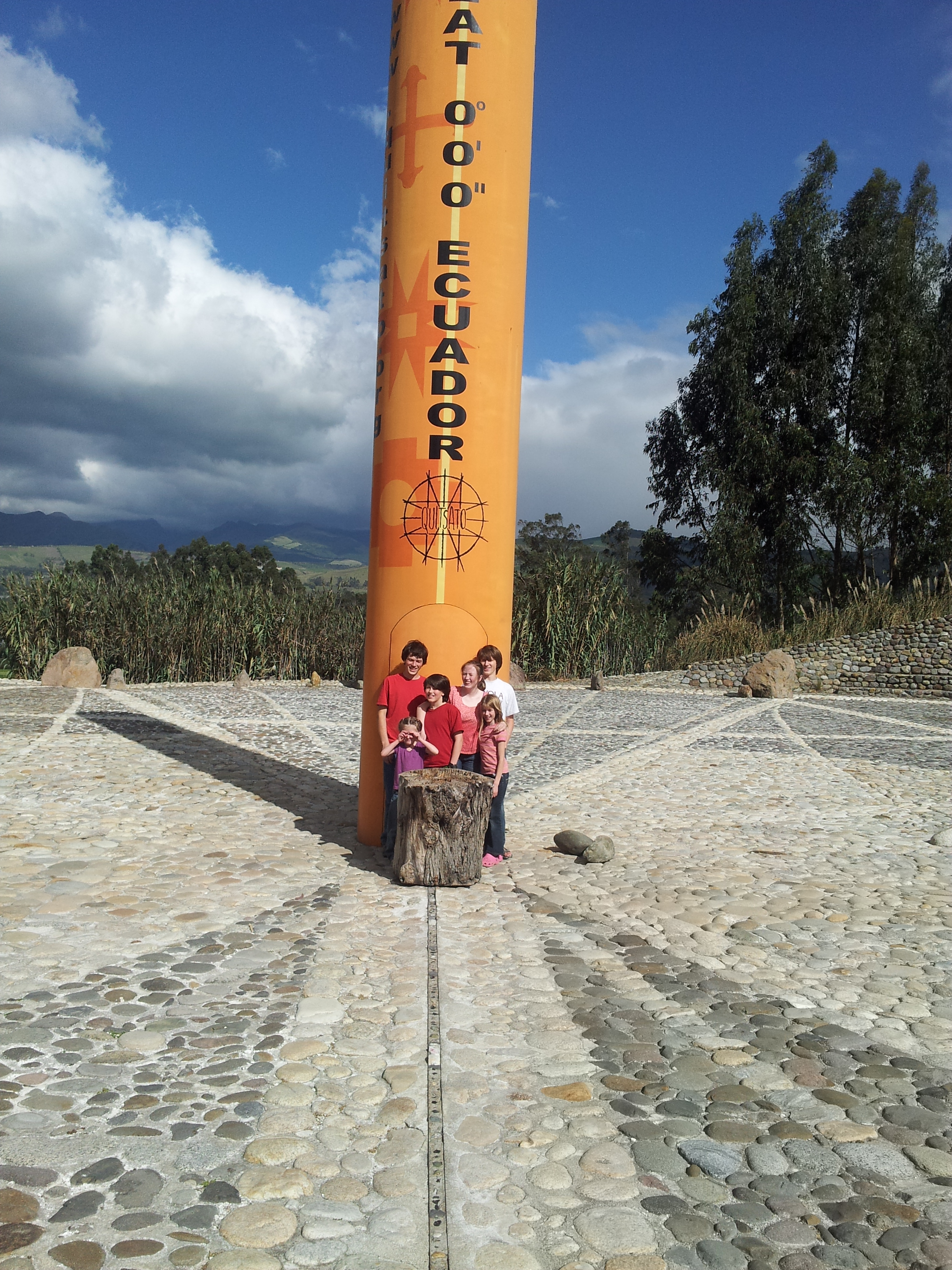
We crossed the equator – which is very exciting. It is summer here now. When we got there, several old British people were planking across the equator and having their photo taken. The water goes down the drain in the other direction. It’s pretty exciting.
What was also exciting was that we came across a Ford dealership! This is exciting as we needed new rear leaf springs for the van. Apparently it is hard work, pulling a 29 ft camper over the Andes.
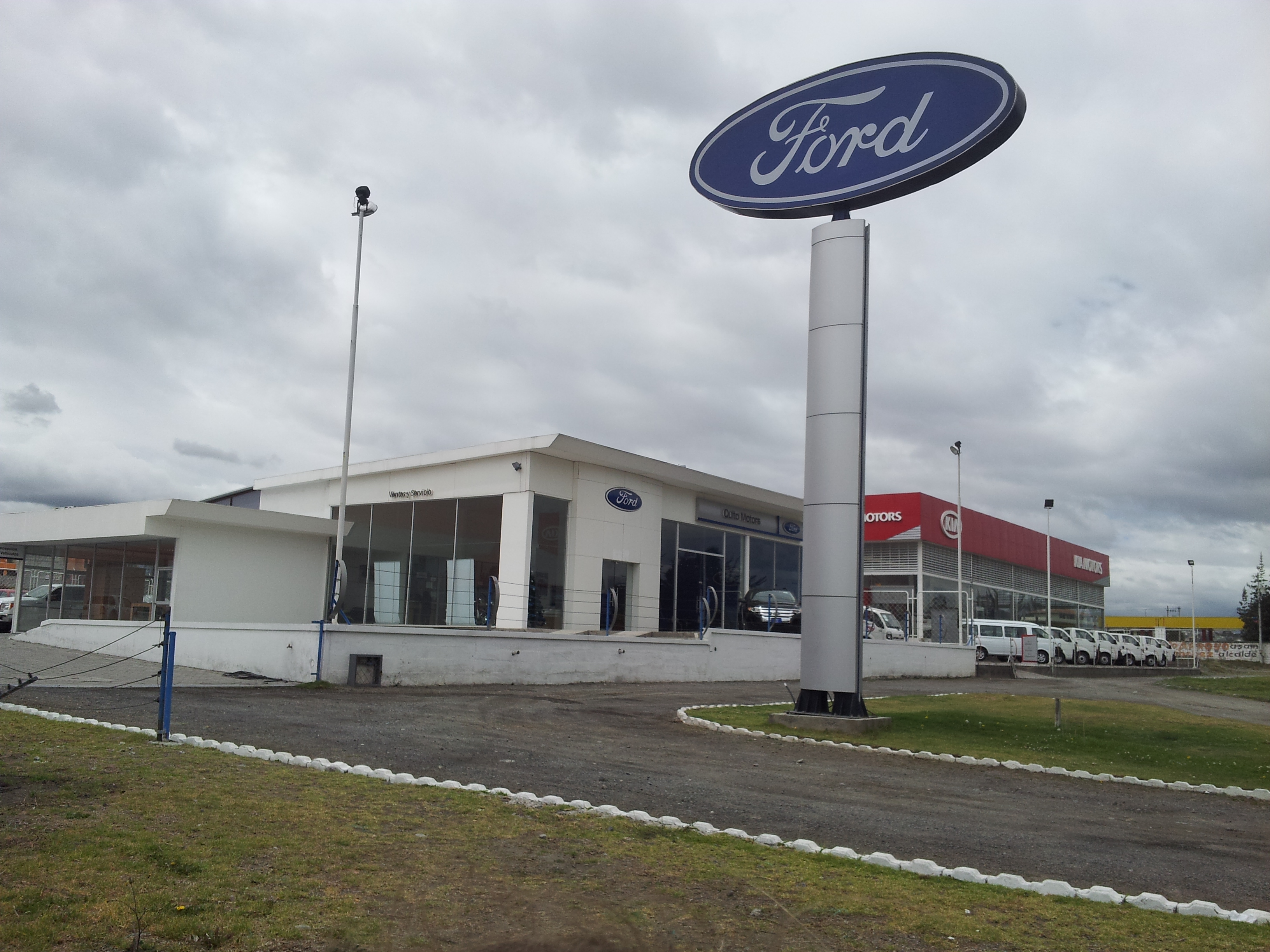
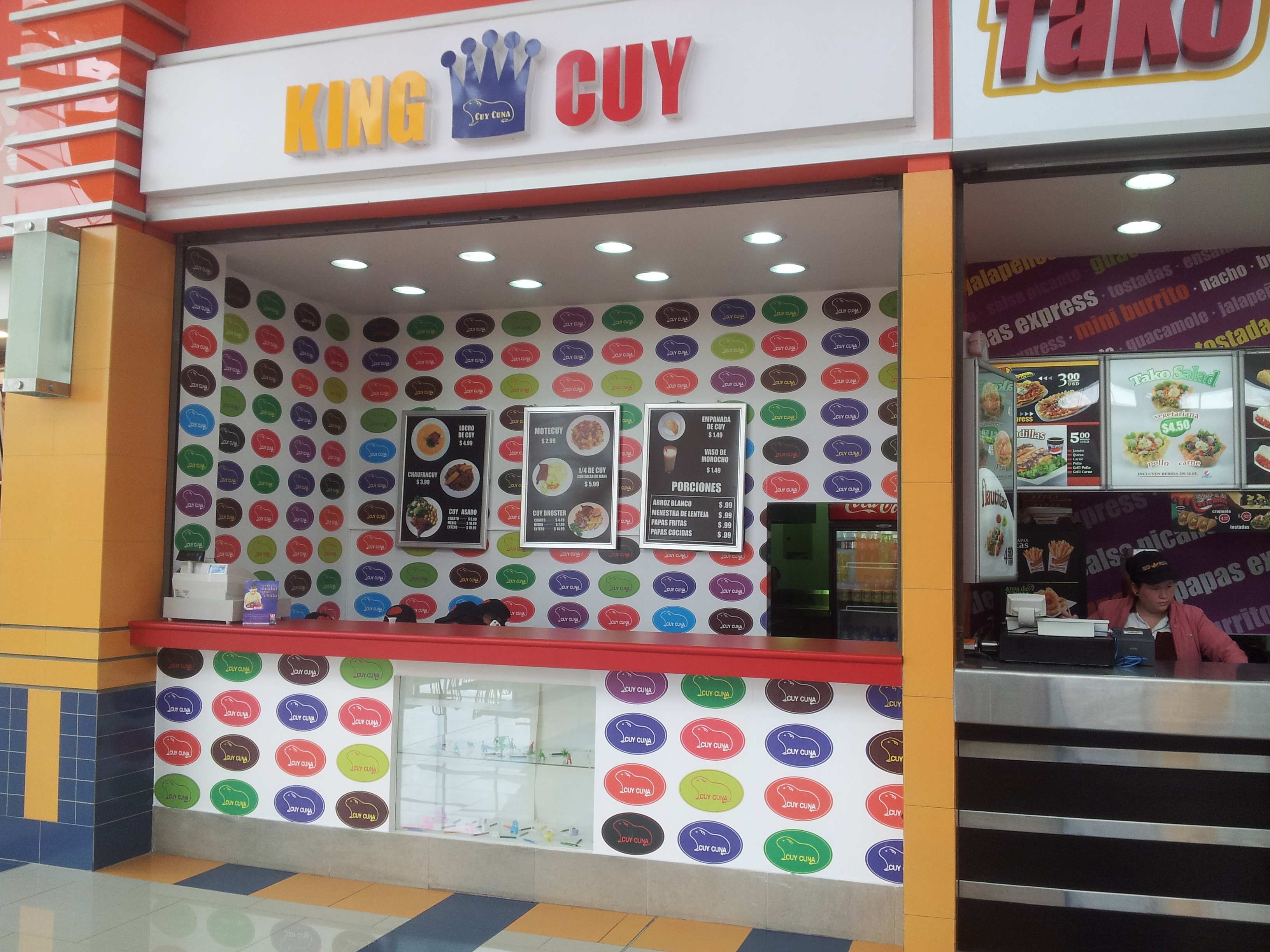
Mark ran inside Ford and we headed to the Latacunga Mall where we shopped in a glamorous, new and nearly empty mall. The food court had a restaurant called King Cuy Cuy (kwee) – that means guinea pig.
After shopping, we went looking for Mark and the Ford guys said he was around the corner in the shop. Which was here, in the street by the train track.
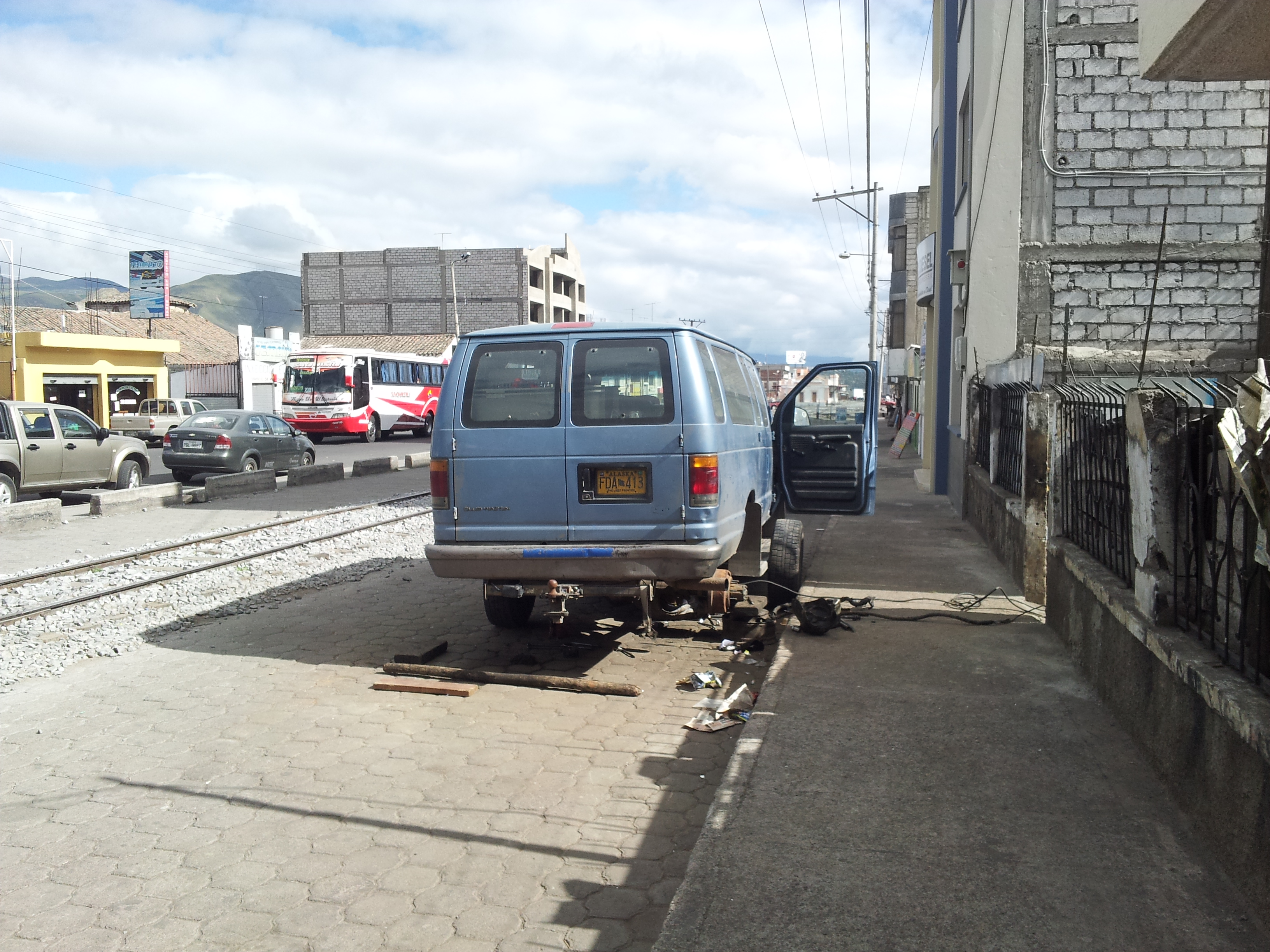
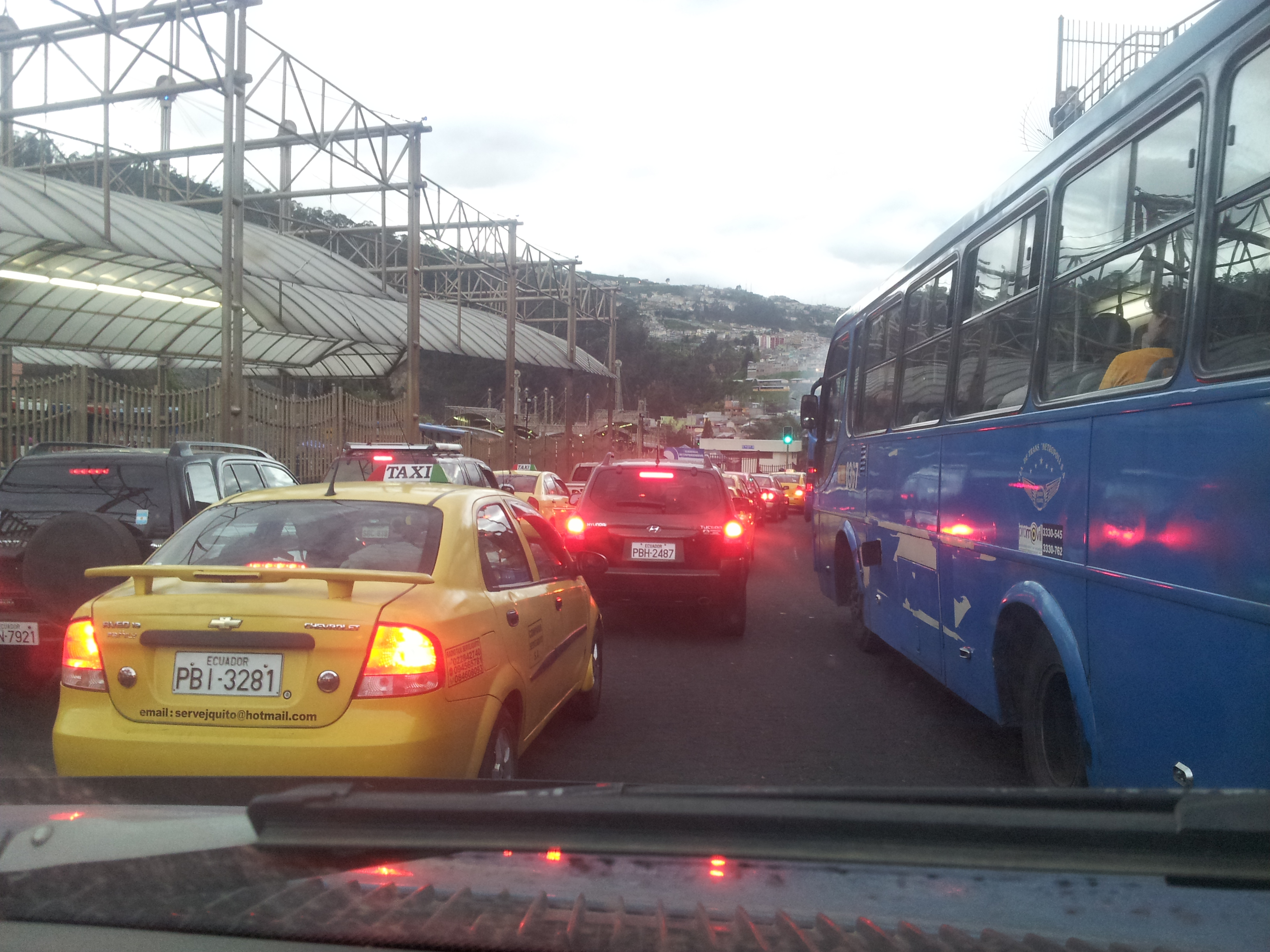
Ford fixed the leaf springs and then somehow jacked them up to be modified leaf springs while Ryan wandered around Latacunga. Here is a photo of driving the Pan American through Latacunga. It can be pretty stressful, bigger cities.
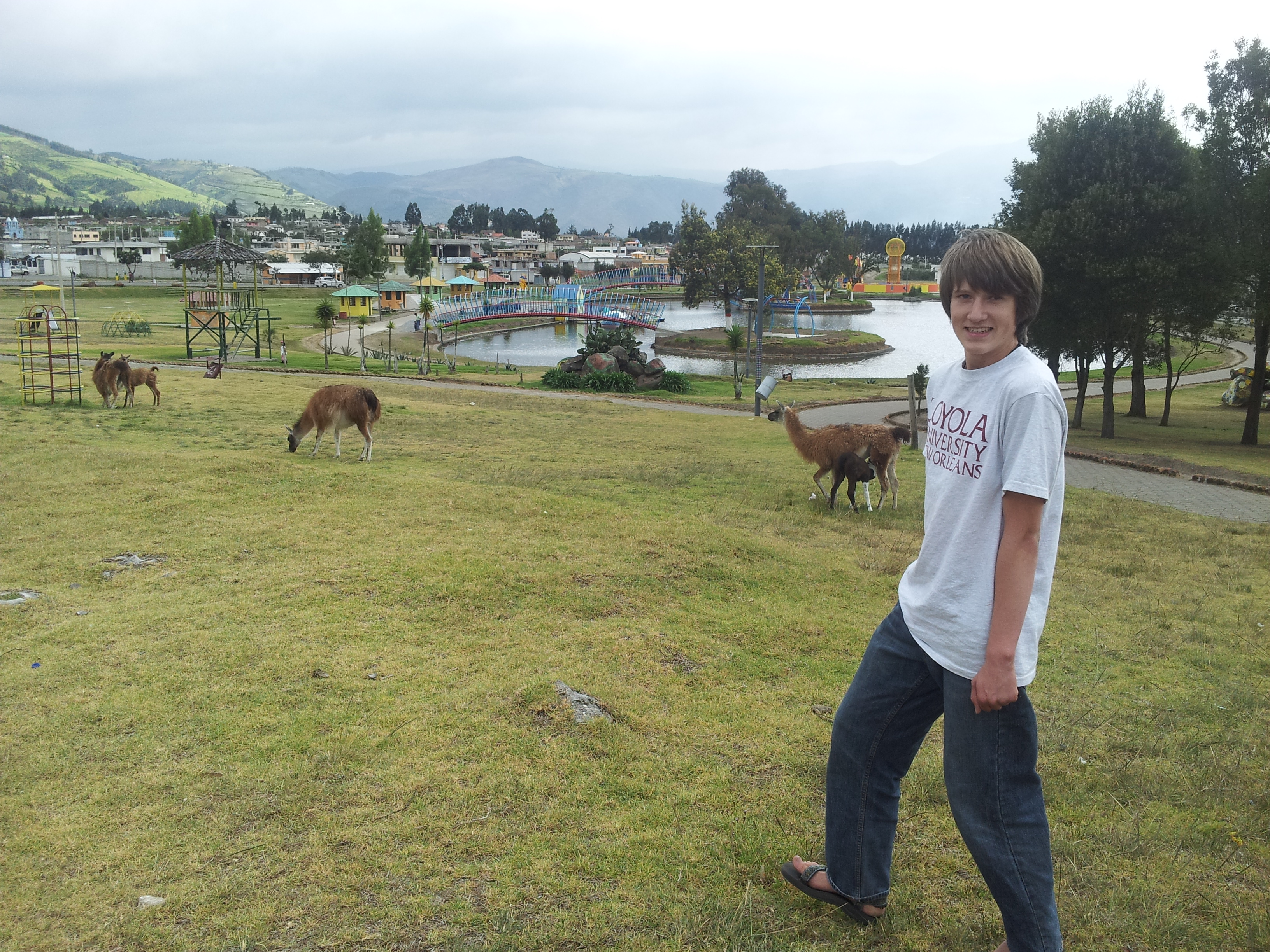
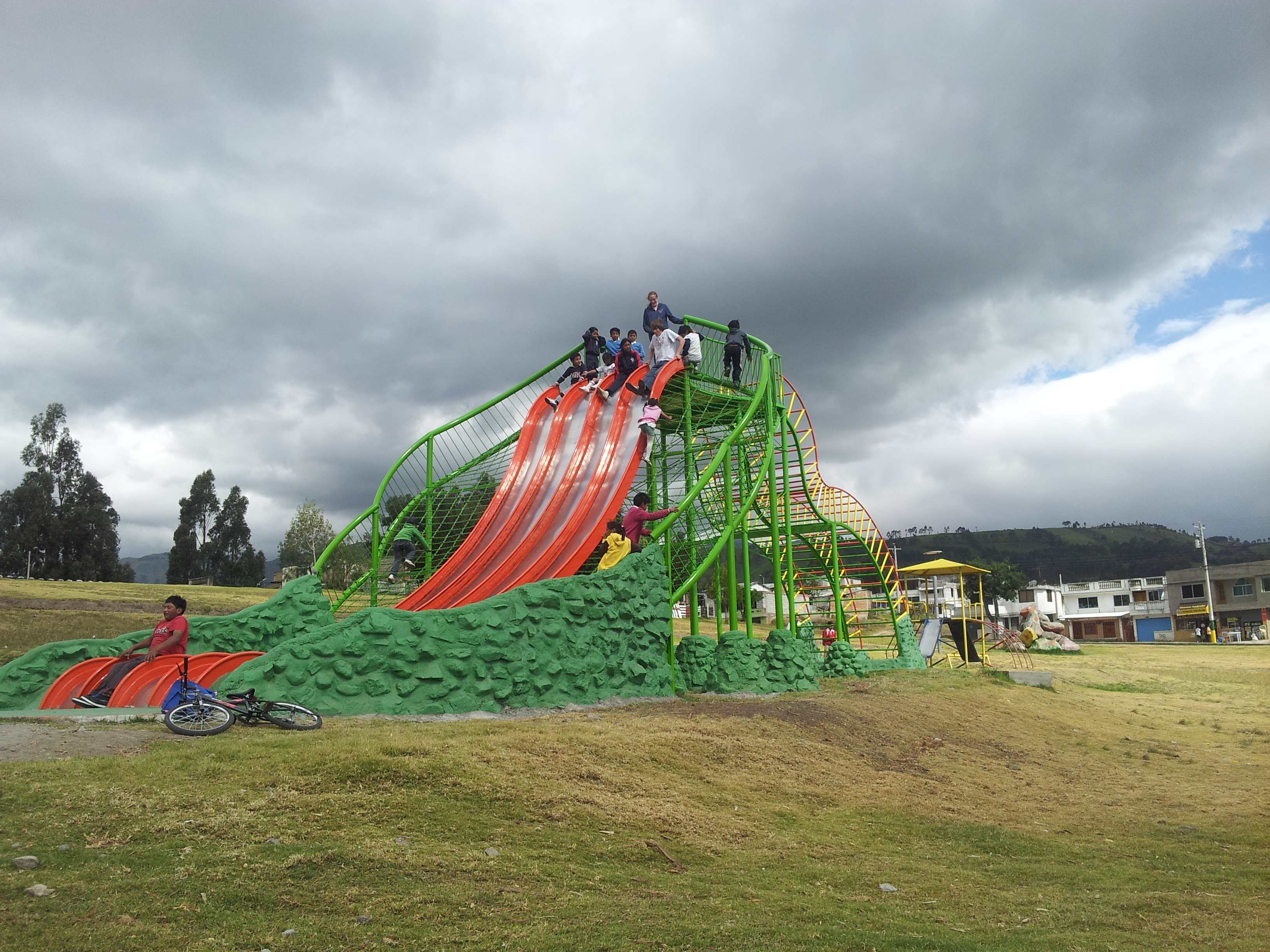
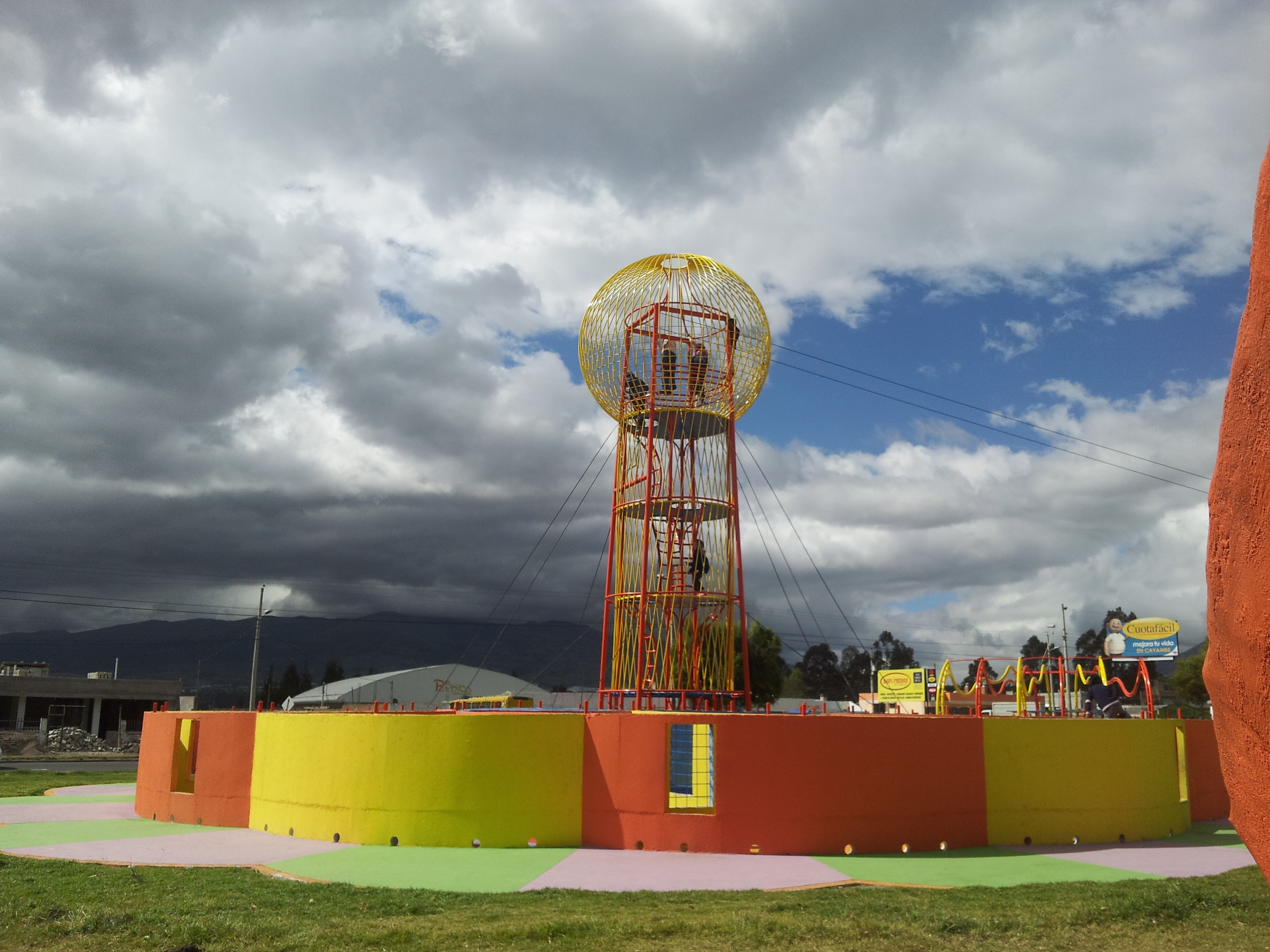
We drove on and found a weird playground with weird, dangerous (actually deadly) slides and such. Alpacas lived there too.
This slide was built on cement and the ladder up is widely spaced monkey bars. I wouldn’t let anyone but Jack & Jen climb up.
Jack went to the top of this thing which is like 30 ft high and has a hole at the top so you can climb out – and then fall to your death as it is a ball of wire above cement. A little kid kept trying to climb out. I couldn’t watch any longer – I had to leave.
We drove to Baños to soak in the thermal springs by the volcano – on the advice of Mary and Brian. We found a great parking spot, a restaurant parking lot that was only open for lunch. We disconnected the camper and drove to Tena (again on the advice of Mary & Brian). It was a great drive through these handhewn mountain tunnels and such. The jungle was beautiful.
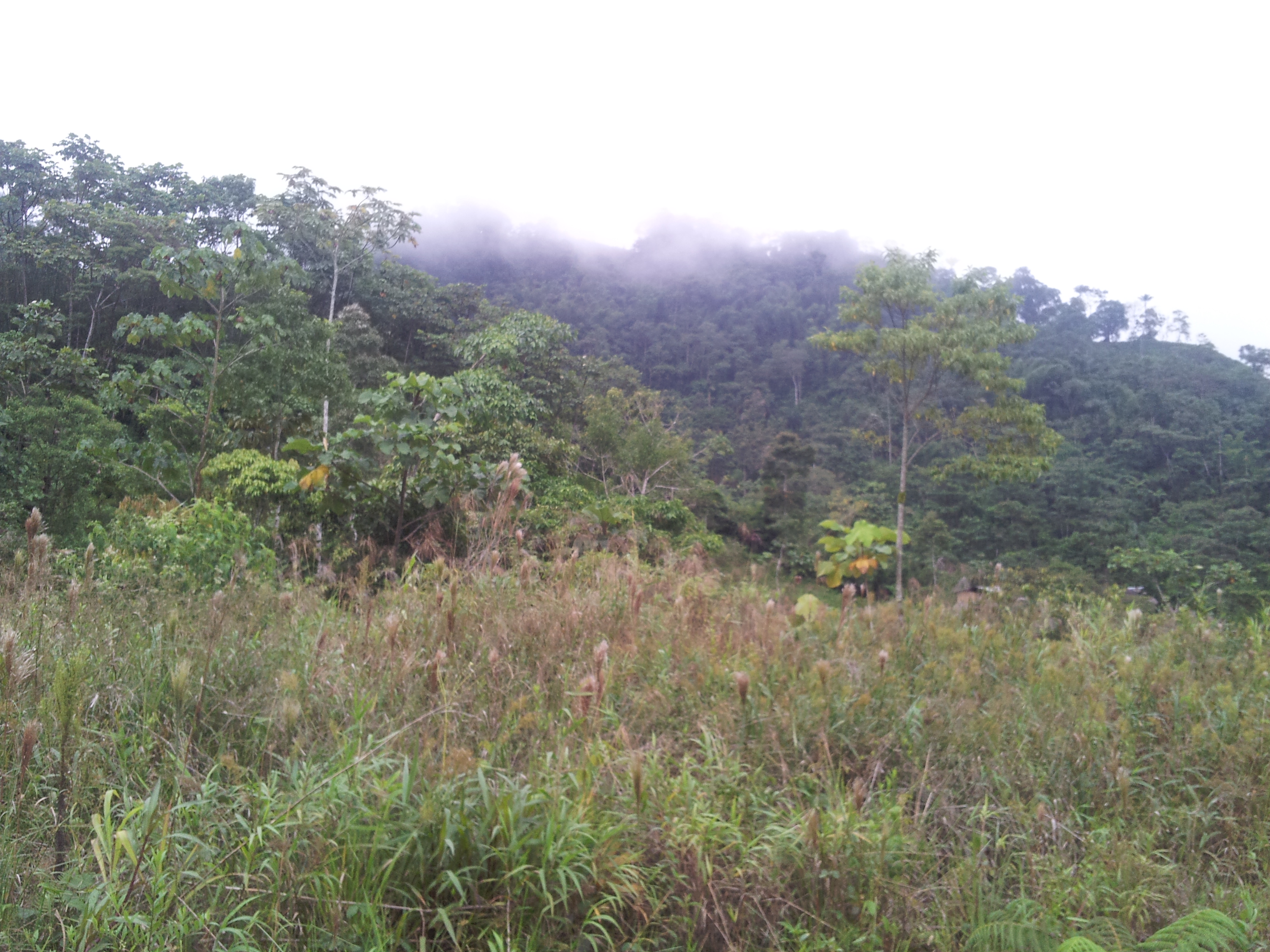
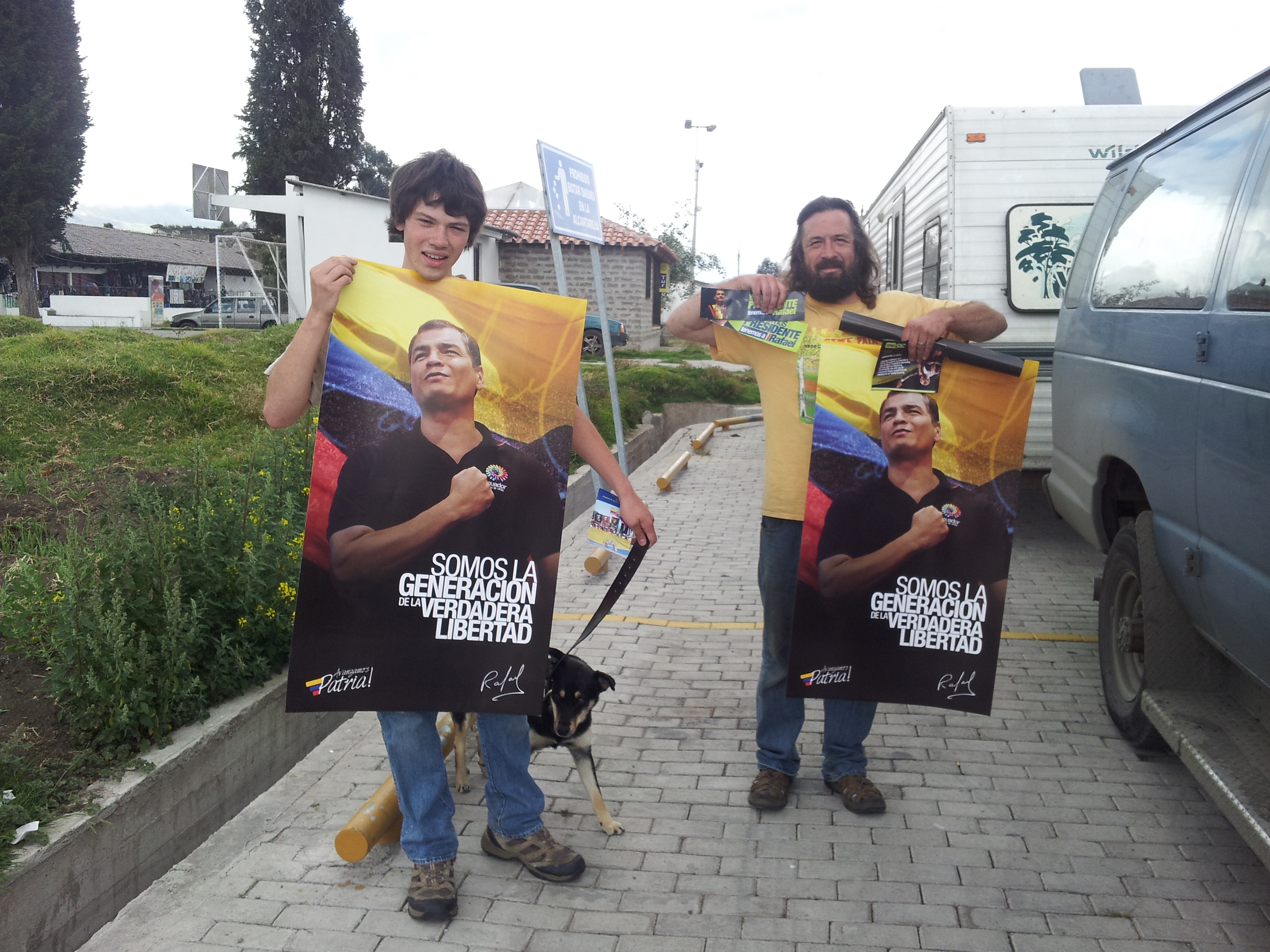
Mark and I liked Tena so much, we talked about retiring here! Ryan got a poster of the President of Ecuador Rafael Correa from the campaign office in Tena – he had wanted one for awhile.
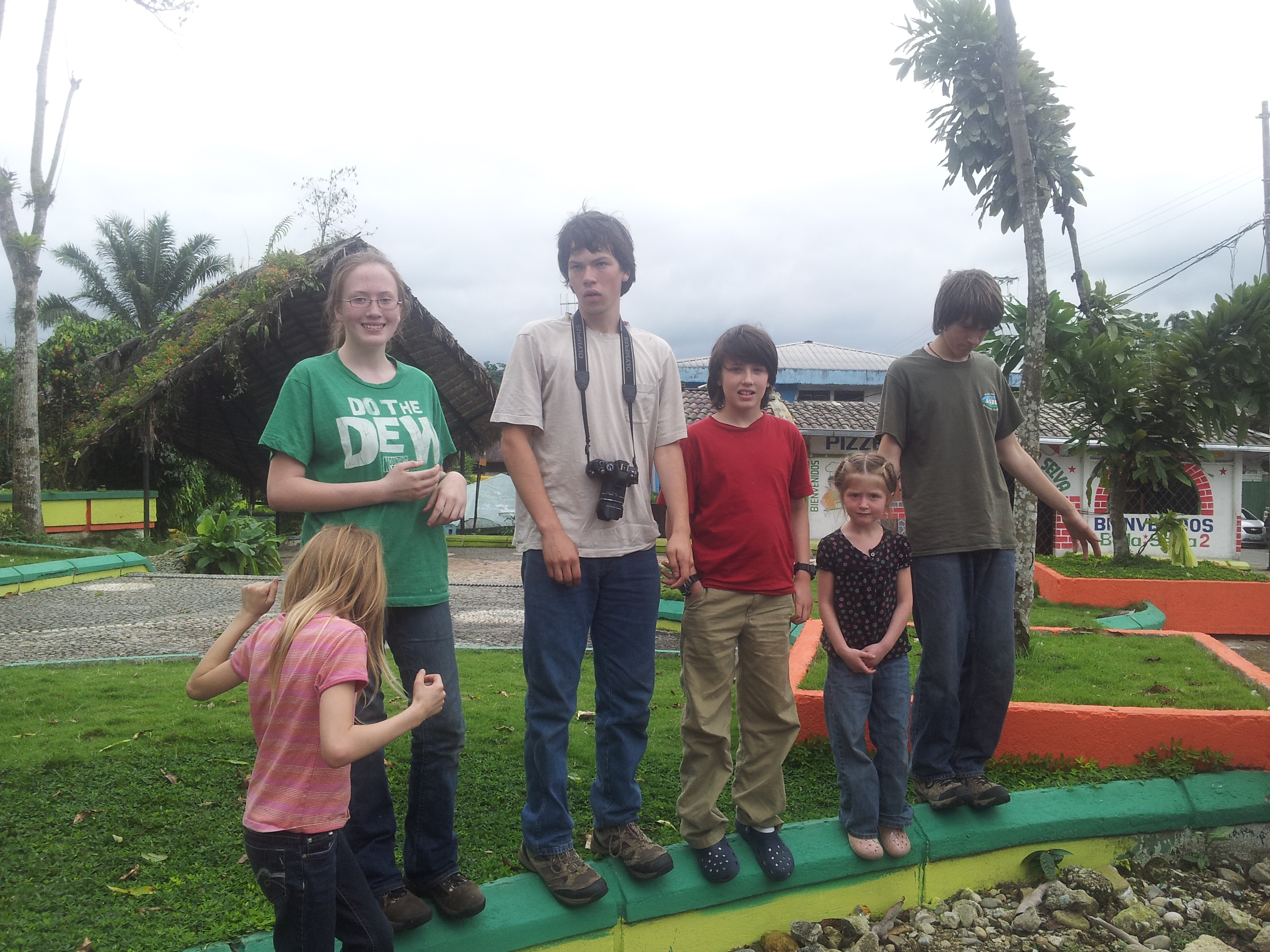
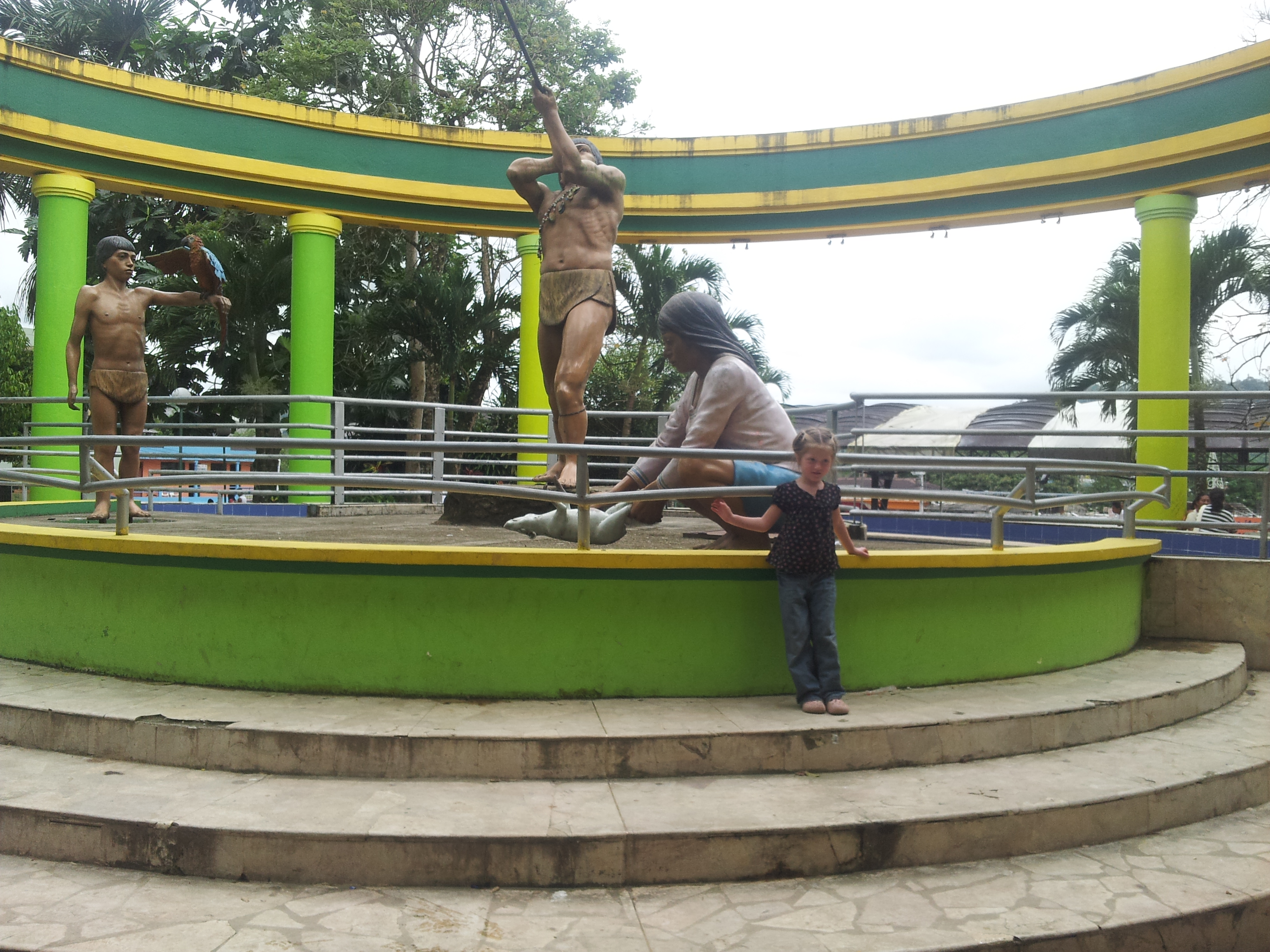
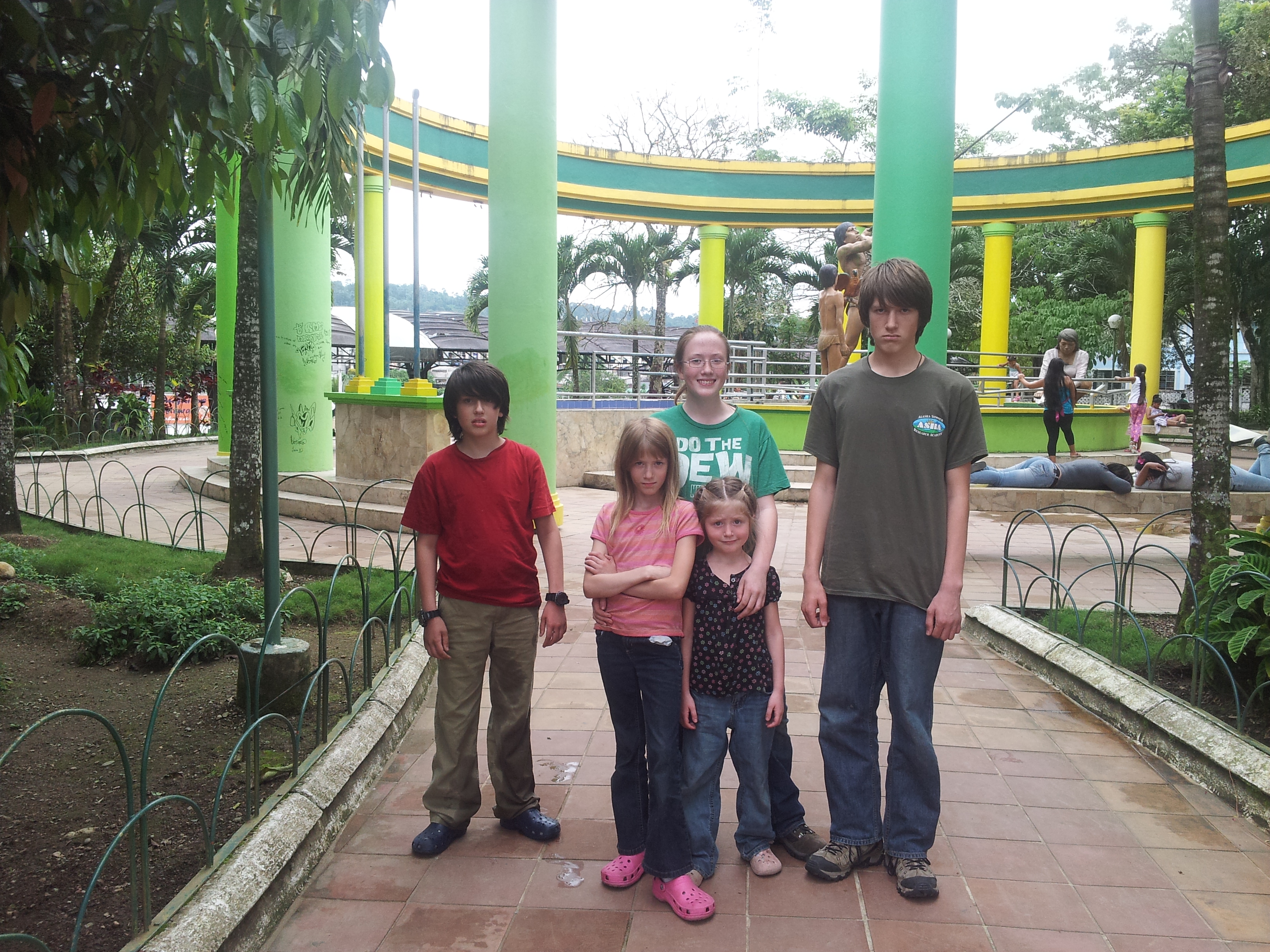
Then it was date night in Baños which was not as fun as it may sound. Seems like everything in Ecuador closes at 7pm.
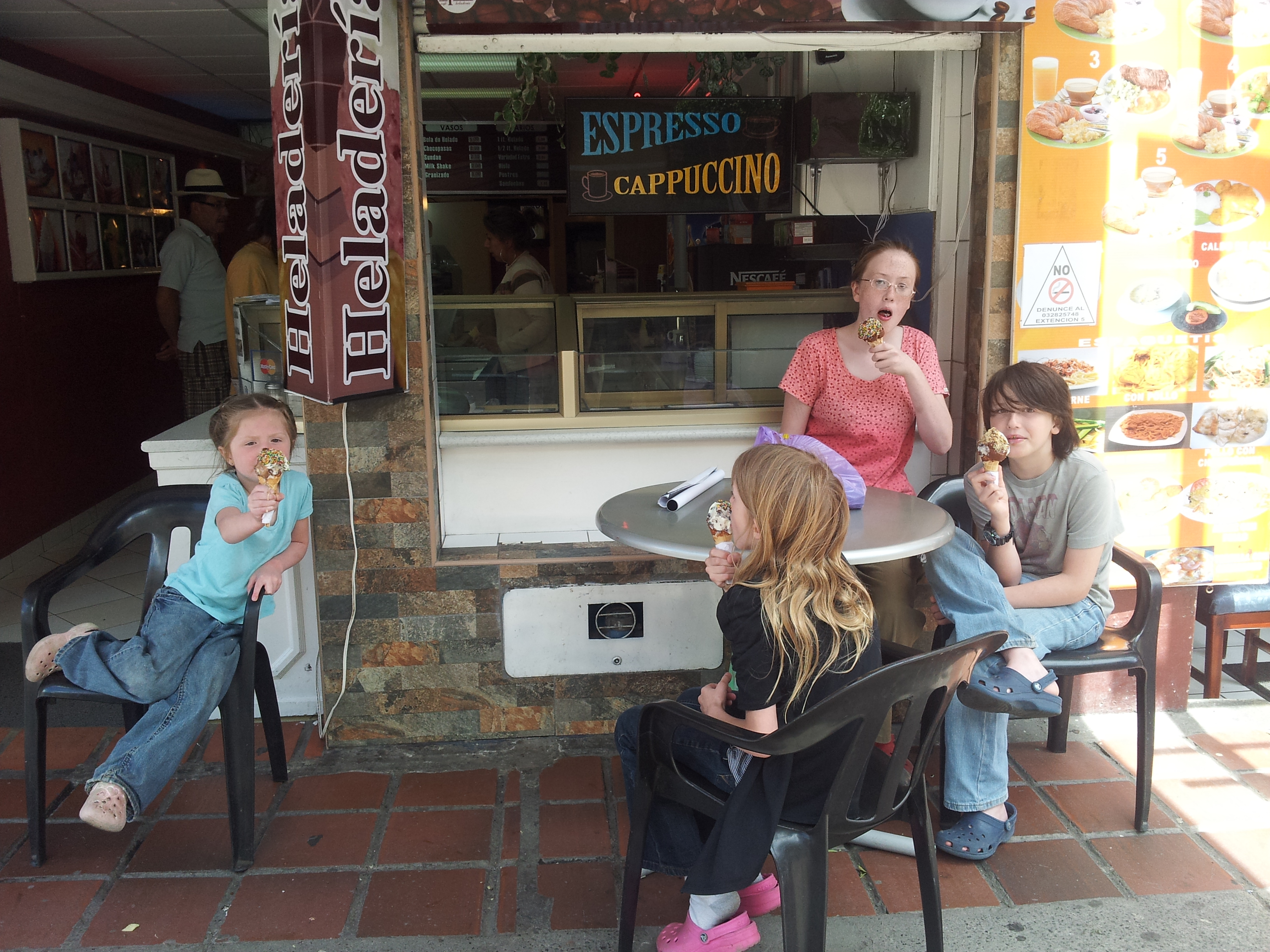
Ecuador has a lot of ice cream which keeps Sylvia happy.
Ryan got more posters of Rafael Correa when we stopped at the Oldest Church in Ecuador and camped in the massive parking lot. At 7pm, the police set up a road block directly next to our camper so for the next three hours we were extremely safe but the police had their lights on the entire time. And there was a lot of megaphone talking. People here love megaphones.
We were unsure if we wanted to continue across the Andes to Peru or head down to the lowlands and cross into Peru that way. Both had good and bad points. Driving through the Andes is beautiful but slow. Driving through the lowlands is fast but hot. We finally decided on the Andes route.
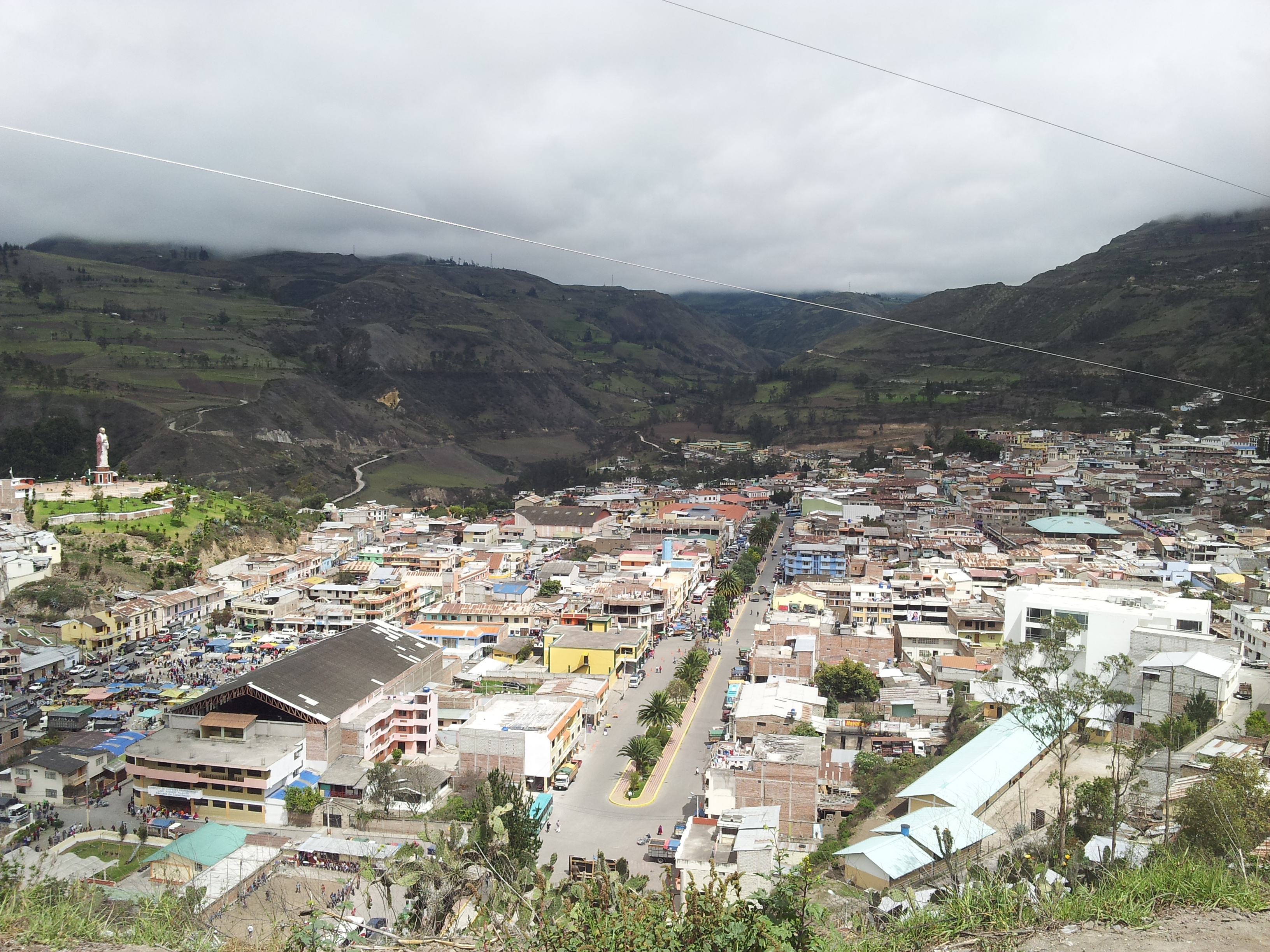
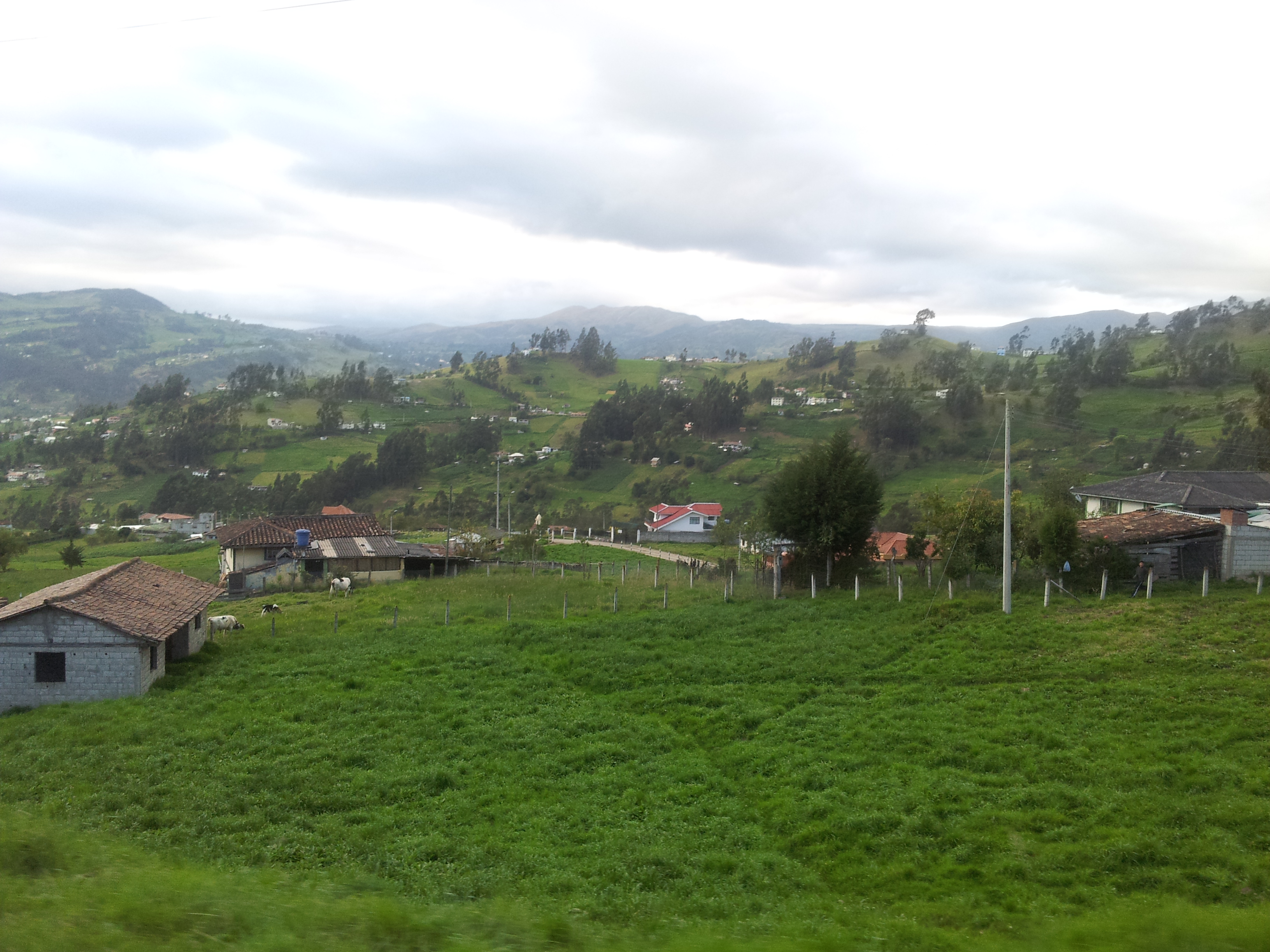
We arrived in Cuenca and have been here for three days. Mondays & Tuesdays are work days for me and we also had work samples for school due. We found a GREAT place to stay – a gas station and parqueadero just south of Cuenca called Rancho Alegre / Petro Comercial. It has a mini market and it is on a field of cows and they have free wifi (a life saver!) and the people here are really kind. One of the people here is from Peru and he gave us a long list of good places to camp. We are planning to leave tomorrow.
]]>
It’s been a long time since I last posted. A lot has happened. I have been busy. I almost missed the entire country of Ecuador.
I had to check my website to see where I last left off.
I have a couple of gigabytes of photos to sort through; I haven’t uploaded yet. I dislike scenic photos—they hold no artistic value beyond a certain point. Anyone can go to a beautiful place, like Andean Colombia, and take a good photo. There’s no challenge. I don’t want to look through a book of photos of beautiful, over saturated landscapes. I much rather would look through a book of interesting and unique photographs—ones that capture a unique and interesting point of view.
^This, is my paragraph explaining why I don’t plan on uploading many scenic photos. If you want to see them, I’ll be happy to email them to you, or, better yet, come over to my house. But I don’t want a website filled with mediocre photos of excellent, albeit uncaptureable, subjects.
I have ~3GB of photos to sort through, then once I have the good ones, I need to mark them up digitally, adjust color spectrums, or the lack there of, adjust settings… Then to upload them, I have to condense the 5MB files and put a stamp on them. It’s an arduous and time consuming process especially when I have so much other stuff to deal with.
Enough with photos.
I have a new dog. Her name is Lucy—or maybe Salchi. It’s actually both, she’s confused enough already, why not add another thing? I found her in Otavalo, where she started following me in the town square. I’m nice to animals, I give food to stray dogs if I see them when I go out for lunch, those sort of things. But I didn’t do anything to Salchi when she started following me. She followed me, my brother and my dad five or six blocks one night to a restaurant, then found me again when I walked by the square. The next day she followed me all day long, sleeping under our trailer. It was really impressive for a stray dog, let alone any dog. The second day, I went out to the square to ask if she was anyone’s pet—she wasn’t.
It’s a bad idea to take a stray dog from urban Ecuador. That’s where we were for a few days. But she was extremely well behaved, and she followed me for four miles the one day while I walked all over the city. I asked the veterinarian across the street if he neutered dogs and gave vaccinations; that would come to $120 total, he told me. We decided to get Trek fixed as well, and that we were going to keep Salchi.
These two operations have consumed my past week almost entirely. I already wrote an incredibly dry page on it for my Veterinary Science class. In summary, the vet screwed up Trek’s surgery, never sealed off the blood vessels, and didn’t put stitches in. I got him to put some in after the fact, but it was a little late, and the stitches were awful. Trek broke them open three times before we left Otavalo. I took Trek to a Veterinarian in Latacunga, and she put in another set of sutures and gave him half a dozen different medications. But Trek broke those stitches open. Now I’m going to head into town today or tomorrow to try to find surgical glue. Because it’s so much fun to try to communicate something that may not even exist down here. I had to ask eleven people in Latacunga for directions to the vet. But doesn’t it seem like surgical glue might be more common down here? The FDA didn’t approve it in the States until; the late 90s, but it had already been in use in the rest of the world since the 1970s.
So, in Otavalo, I lost a dog, then gained a dog, then had a dog injured by an incompetent veterinarian.
Salchi seems to be a really great dog so far. She’s small, she has Doberman Pinscher eyes (though it’s not unattractive) and an almost Siberian Husky body/coat. She’s about thirty-some pounds because she’s really overweight—she subsisted almost entirely off of French fries in Otavalo—but she should be about twenty when she’s down to a normal size. She’s about sixteen inches tall at the shoulder.
We left Otavalo late in the day because of veterinary problems, and made it to the other side of Quito by about 8:00pm. Quito looked beautiful, but we couldn’t stop because the trailer was too unwieldy. We stayed at a gas station covered with beetle carapaces—piles of them, all about the size of a penny.
The next day we got to Latacunga. We saw a Ford Dealership on the way in, so my dad stopped to see if they sold leaf springs for the van. The rest of us went to the huge mall to wait. I got my Claro problems sorted out at an office there, so I now have data on my iPhone. I also realized that my Galaxy S II retails for $1100 down here, and my iPhone 3Gs would probably get $600. Anyone from South America who’s reading this: I paid $150 for my iPhone used, and $200 for my Galaxy S II. I’m not nearly that rich. The mall in Latacunga had a fast food cuy restaurant named “King Cuy” and wallpapered with anthropomorphic guinea pigs.
Someone offered to fix our van for cheap, so we drove it down the road about 500 meters to his shop, and waited. About this time, we decided that Trek needed more medical attention, so I left to look for a veterinarian. An hour and a half later I found one, then called a cab back to get Trek. Once I got the dog to the veterinarian it took about two hours. He needed to be anesthetized again for more stitches, and he had several more injections. I bought him an e-collar, which it turned out was two inches too short.
We left Latacunga late and drove to a gas station where we could park for the night, about an hour’s drive from Banos.
Banos, had giant spiders. I haven’t seen many bugs since I’ve been down here, the Washington DC greenbelt still holds the Western Hemisphere record for incredible amounts of bugs. Nothing has even come close. But Banos did have very large spiders. I saw a two-inch, yellow one in a web near the ground while walking my dog, at which point I decided the walk was now over, and then turned around to see a 4+ inch spider run under a rock. At that point, I had had enough of Banos for quite some time.
We drove down the valley that day, and then took a spontaneous detour to the Amazonian city of Tena—something you can do when gas is a dollar a gallon. It was a great trip, completely exotic. Somehow, we had managed to drive from Cartagena to here without actually seeing the rainforest. It was like being in a completely different country. One website described it as a town where Indiana Jones would stop for supplies before venturing into the jungle. It’s an apt description if Indiana Jones also had a passion for cellphones and playing MMORPGs or updating facebook at one of the numerous internet cafes. Tena even had this awesome rickety suspension footbridge made out of rusting steel beams and heavy steel chains over a jungle river. We didn’t have a lot of time to spend there as we wanted to get back to Banos by dark, and it was a two hour drive away.
Back in Banos, we spent the night in a parking lot and got up the next morning to go to the thermal baths, then we left town. We spent that night in the parking lot of the oldest church in Ecuador that was also the cross roads for the mountain highway and the coastal highway. We decided to go through the mountains the next morning to avoid the coast. It turned out to be a good idea, and we drove for several hours through what looked like a mountainous Shire, until we hit clouds on the other side of the mountain range. We got into Cuenca at about 6:00pm, where I’m at at the moment. It looked like a beautiful city when we drove through, and we’re going to drive in tonight. I need to buy some surgical glue, which I’m expecting isn’t going to be pleasant.